
Why is my fuel bill higher than the kilometres say it should be?
Because the run was costed on an average and the run was not average. The same truck reads 16 litres per hundred one day and 24 the next, and the quote only ever saw one number.
The short answer
A refrigerated truck does not have one fuel figure. It has a range, and the range on one of ours runs from 16 to 24 litres per 100 km (about 15 to 10 mpg). The average over two years sits at 18 and has barely moved. A quote built on 18 for a day that comes in at 24 is a third out on fuel before the truck leaves the yard, and nothing on the invoice will tell you which day it was.
Two lines on a web page
The first cost calculator I built had two things in it. Litres per hundred, and a driver's wage per hour. That was the whole model. It lived on a web page, it could not save anything, and every quote started from a blank screen with the same two numbers typed in from memory.
It was not wrong, exactly. Fuel and wages are the two biggest lines on a delivery run. What it could not do was be checked. When a job came back thinner than the quote said it would, there was nothing to reconcile the quote against, because the quote was gone.
Where the number came from
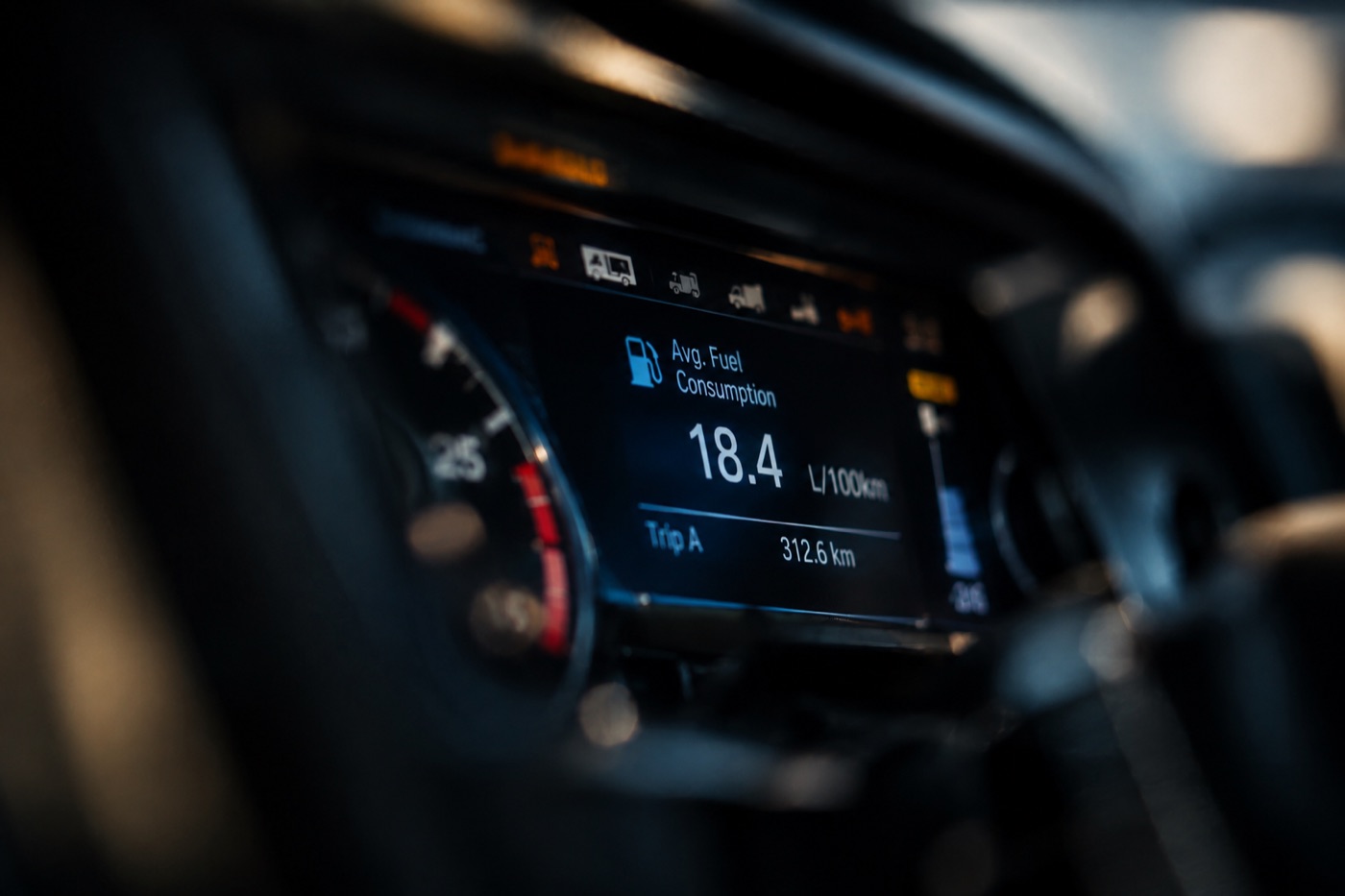
The litres-per-hundred figure came off the dash. Every truck we run has a fuel economy readout in the menu next to the trip meter, and that was the source. Not a fuel card, not a spreadsheet, the truck's own opinion of itself.
Nobody writes it down. I read it off the dash myself every few months, and it is a fair number. On a given day it moves by one or two litres per hundred at most. Over the last two years the big truck has read 18 and the smaller ones about 12, near enough every time I have looked.
Sixteen to twenty-four
The average being stable is not the same as the day being stable. The same truck that averages 18 will read 16 on a light run and 24 on a heavy one. The smaller truck goes from 10 to 18.
What sends it to the top of the range is mostly the driver. The right foot does more to that number than anything else on the truck. A full load is next, because a heavy truck uses more fuel than a light one and there is no way round that. One of ours also has a power button that holds the automatic in a lower gear, so the engine sits at higher revs, and fuel goes with revs.
The fridge is in there too. Every truck we own runs the refrigeration off the main engine. There is no separate unit and no separate tank, so whatever the fridge burns is already inside the dash reading and inside the fill-up. You cannot pull it out afterwards and put it on its own line. Trucks with an independent reefer unit are the other case: a second tank the odometer never sees at all, burning on time rather than distance, parked and overnight. If you cost off a dry-freight average, that fuel does not exist until the bill arrives.
What the wrong end of the range costs
Take a 300 km run (186 miles) on the big truck. Diesel near our warehouse is A$2.60 a litre today.
At 18 litres per hundred the run burns 54 litres (14 gallons) and costs A$140 in fuel. At 24 litres per hundred it burns 72 litres (19 gallons) and costs A$187.
Run Length
300 km
Fuel Range
16–24 L/100km
Gap On Fuel
A$47
That is A$47 on one run, with nobody doing anything wrong. Multiply it by a week of runs on the heavy side and it is the margin. The quote that was built on 18 was not a bad quote. It was a quote with no idea which kind of day it was for.
What I have not done
I have never put the fuel card against the odometer for a month and checked whether the truck's readout agrees with the bill. Being honest, the bill is close enough to the same every month that I have not needed to. The exception is the two months before Christmas, when we are flat out on chocolate and the fuel goes up with the volume, and that is a busy-season line, not a mystery.
The costing lives in the software now and it keeps every run, which is the part the web page could not do. Every truck carries its own litres per hundred, and ours are set at 18 and 12.
The reefer on its own tank
There is a second fuel field now, for trucks with a separate reefer motor. It takes litres per hour and it stays blank on an engine-driven truck, so nothing gets counted twice. Ours are all blank.
The bit that changes the number is the overnight. An independent unit does not stop when the driver does, so a day that ends with the trailer still loaded is 24 hours of reefer, however short the driving was. I put a test run through it to see the shape of it: an hour and twelve minutes on the road on day one, the unit at 3.5 litres an hour, and the night ticked because the load stays on.
| Day | Driving | Reefer hours | Reefer diesel | Cost at A$2.60 |
|---|---|---|---|---|
| Day one, trailer loaded overnight | 1 h 12 min | 24 | 84 L (22 gal) | A$218 |
| Day two, empty leg home | 53 min | 0.9 | 3 L (0.8 gal) | A$8 |
Day one comes out at 84 litres (22 gallons) of reefer diesel and 250 kg of CO2, against about 8 litres (2 gallons) and 25 kg for the driving. Day two is the empty leg home with the fridge off in the motel car park: three litres, A$8. There is no fixed per-night figure in there. A driver stops for eight hours or for fourteen and the software cannot know which, so the night is whatever is left of the 24 hours once the run is done, and the dispatcher unticks the nights the trailer is empty.
If you are quoting off one number, go and find out what your range is first. The truck already knows.
Plan tomorrow's cold-chain runs tonight.
Start your free 30-day trialNo card required. Already have an account? Sign in.