
How do I prove the thermometer itself is telling the truth?
We had three thermometers that agreed with each other. A customer's auditor wanted a fourth one in a cup of ice, and I argued about it.
The short answer
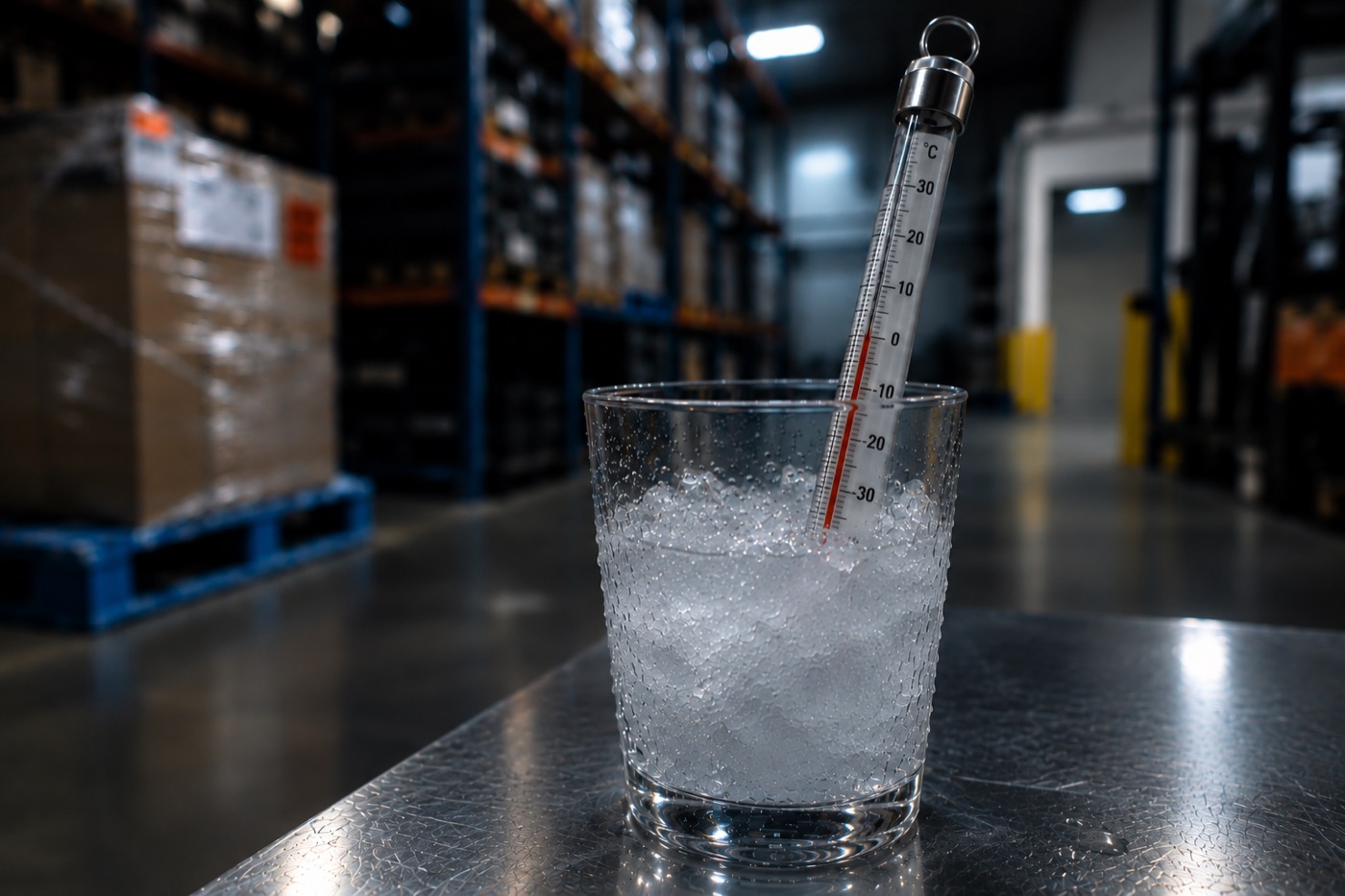
Put the instrument in a stirred slurry of ice and water. While there is both ice and water in the container, the mix sits at 0°C. It does that because of what water does when it changes state, not because anyone set it. So anything you dip in should read zero, and whatever it reads instead is how far out it is.
The reference is the ice, not the thermometer in your hand.
The argument I had
We already had three instruments. The coolroom readout, which warehouse staff read twice a day. A handheld digital thermometer, held against that readout once a month. A spot meter if those two ever disagreed. Trucks and refrigeration units calibrated annually on top of that.
The auditor from a chocolate manufacturer we carry for wanted a mercury thermometer in an ice slurry. My argument was that a mercury thermometer is an instrument too. Glass gets knocked, a column can separate, and being old and analogue doesn't make a thing honest. If you're worried an instrument is wrong, a fourth instrument is a strange fix.
Our HACCP auditor was happy with the three, and said so.
Where he was right
Three instruments agreeing proves they're consistent. It doesn't prove any of them is correct.
I didn't hear that at the time. If the handheld and the readout both say 15°C, either the load is at 15°C or they're both out by the same amount, and nobody in the building can tell which. Same make, bought the same year, sitting in the same coolroom. Drifting together isn't the million to one I thought it was.
What we had no version of was an anchor. Something with a known value that doesn't depend on an instrument to tell you. Ice water is that, and it's the only thing in the building that is.
Where I still think I was right
The mercury thermometer can still be faulty, which was the whole of my point.
It just doesn't matter much, once both instruments go in the same slurry and both get read against zero rather than against each other. If the mercury says 0.4°C and the spot meter says 0.4°C, they agree beautifully and they're both out, and the only reason you catch it is that the answer was always supposed to be zero. Read the spot meter against the mercury and you've rebuilt the problem the slurry was brought in to solve.
So the mercury isn't the reference. It's one more instrument being tested, which is what I was saying, inside a method that works, which is what he was saying.
What close enough means depends on what's in the truck
Our coolroom runs at 15°C. Chocolate is fine under 22°C, which is the manufacturer's own figure off the packaging, and we work to 21°C to give ourselves a degree. That's six degrees between where we hold it and where it stops being fine.
So a meter reading 0.8°C in ice water is out by 0.8°C, against six degrees of room. It changes nothing anyone does. And nothing has ever been out by more than a degree here — not the handheld, not the spot meter, not the readout, and not the trucks or the refrigeration units when the technicians calibrate them each year. For chocolate, at our temperatures, the check is close to ritual. A bag of ice and five minutes, so it's cheap ritual, and I do it.
Put seafood at 4°C in the same truck and that same 0.8°C is a different number. There's no six degrees to spend. The margin is the whole thing.
Nearly everything written about calibration is written for the seafood case. Daily ice-point checks, a probe, a kitchen, a lab certificate every year or two. Good advice for a restaurant, handed to people carrying pallets of something with room to move. The check is the same either way. What the result is worth isn't.
The label we've never printed
Anything more than a degree out gets a label with its offset stuck on it, so whoever picks it up knows what to take off. That rule has been there the whole time. We've never printed one.
The checks go in a spreadsheet the HACCP auditor can open. A check you remember doing is worth nothing in March when someone asks to see the year.
Where to start
Bag of ice, cup of water, and the thermometer you actually trust decisions to. See whether it says zero.
Then work out what a degree is worth to what you carry, because that's what decides whether the answer matters.
Plan tomorrow's cold-chain runs tonight.
Start your free 30-day trialNo card required. Already have an account? Sign in.